
Strategic Communication
Managing Information During a Cyber Security Crisis

In the immediate aftermath of a security breach, the instinct for many small business leaders is to either retreat into silence or react with frantic, uncoordinated messaging. However, a crisis is not merely a technical challenge; it is a communication challenge that directly impacts your brand’s longevity. For small businesses, where reputation is often the primary currency, how you speak during a crisis is as important as how your IT team remediates the threat.
This guide outlines a calm, practical framework for executive-level communication during a security incident. By focusing on transparency, accuracy, and stakeholder trust, you can navigate the complexities of a breach without causing secondary damage through poor messaging.

The Architecture of Crisis Communication
Effective communication during a crisis requires a shift from marketing-driven language to a “need-to-know” operational style. The goal is to provide a steady hand, ensuring that employees, partners, and clients feel informed rather than overwhelmed.
1. Establishing a Single Source of Truth
In the first hours of an incident, rumors fill the vacuum left by a lack of information. To prevent internal and external confusion, you must establish a centralized communication hub.
Designate a Lead Spokesperson: Usually the CEO or a senior executive, supported by legal and technical advisors.
Internal Briefings: Before any public statement is made, ensure your staff understands what has happened and, more importantly, what they are authorized to say (or not say) to outside parties.
The Log of Truth: Maintain a private, chronological record of all communications sent. This ensures consistency and prevents contradictory statements in later phases of the investigation.
2. The First 24 Hours: Accuracy Over Speed
While the pressure to “say something” is intense, providing incorrect information is more damaging than a slight delay. If you announce that no data was stolen and the forensic team later discovers otherwise, you have compromised your credibility.
Acknowledge the Incident: Confirm that you are aware of an issue and are investigating.
Avoid Speculation: Do not guess the identity of the attacker or the specific methods used until the technical audit is complete.
Focus on Action: Detail the immediate steps taken to contain the threat, such as taking systems offline or engaging third-party forensic experts.
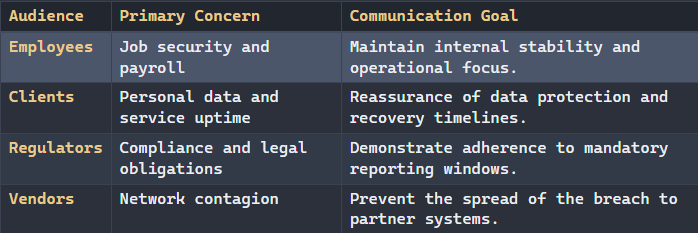
3. Stakeholder-Specific Messaging
Not all audiences require the same level of detail. Tailoring your message ensures that you address the specific anxieties of each group without creating unnecessary alarm elsewhere.
Navigating the Legal and Regulatory Requirements
For small businesses, the intersection of communication and legal liability is a narrow path. Every public statement can be used in future litigation or regulatory reviews.
The Role of Legal Counsel
Before hitting “send” on any mass email regarding a breach, your legal team must review the content. They will ensure that you are not inadvertently admitting liability or making guarantees that your insurance policy cannot support.
Meeting Disclosure Deadlines
Depending on your jurisdiction and the nature of the data involved (such as GDPR in Europe or various state-level laws in the US), you may have strict windows—often 72 hours—to notify certain authorities. Your communication strategy must align with these clocks to avoid heavy fines.
Managing the Technical Narrative
You do not need to be a CISO to communicate about cyber security, but you do need to understand how to translate technical findings into business impact.
Explaining “What Happened”
Use clear, non-technical language. If a ransomware attack occurred, describe it as “an unauthorized encryption of files” rather than diving into the specific strain of malware. This keeps the focus on the business impact and the recovery process.
Defining the Scope
Be precise about who is affected. If the breach only impacted a specific server containing legacy data, state that clearly. Broad, vague statements like “our systems were breached” lead people to assume the worst-case scenario.
The Recovery Phase: Rebuilding Trust
Communication does not end when the “All Clear” is signaled. The post-incident phase is where you define the future of your professional relationships.
The “Post-Mortem” Transparency
Once the investigation is closed, provide a summary of what was learned. You do not need to expose your new security vulnerabilities, but showing that you have implemented multi-factor authentication (MFA) or improved encryption standards demonstrates a commitment to continuous improvement.
Ongoing Updates
If recovery takes weeks, maintain a regular cadence of updates. Even if there is no major news, a brief note stating “Recovery is 80% complete, and we remain on schedule” prevents the perception that the business is still in chaos.
Leadership Through Clarity
A security crisis tests the strength of a small business’s leadership. By choosing a calm, business-aware approach to communication, you move the narrative from one of victimhood to one of responsible management. Trust is not lost because an incident occurred; it is lost because of how the incident was handled.